4 Yocto Project Releases and the Stable Release Process
The Yocto Project release process is predictable and consists of both major and minor (point) releases. This brief chapter provides information on how releases are named, their life cycle, and their stability.
4.1 Major and Minor Release Cadence
The Yocto Project delivers major releases (e.g. 6.1) using a six month cadence roughly timed each April and October of the year. Here are examples of some major YP releases with their codenames also shown. See the “Major Release Codenames” section for information on codenames used with major releases.
4.1 (“Langdale”)
4.0 (“Kirkstone”)
3.4 (“Honister”)
While the cadence is never perfect, this timescale facilitates regular releases that have strong QA cycles while not overwhelming users with too many new releases. The cadence is predictable and avoids many major holidays in various geographies.
The Yocto project delivers minor (point) releases on an unscheduled basis and are usually driven by the accumulation of enough significant fixes or enhancements to the associated major release. Some example past point releases are:
4.1.3
4.0.8
3.4.4
The point release indicates a point in the major release branch where a full QA cycle and release process validates the content of the new branch.
Note
Realize that there can be patches merged onto the stable release branches as and when they become available.
4.2 Development Cycle
As explained in the previous Major and Minor Release Cadence section, a new release comes out every six months.
During this six-months period of time, the Yocto Project releases four “Milestone” releases which represent distinct points of time. The milestone releases are tested through the Testing and Quality Assurance process and helps spotting issues before the actual release is out.
The time span between milestone releases can vary, but they are in general evenly spaced out during this six-months period of time.
These milestone releases are tagged with a capital “M” after the future release tag name. For example, the milestone tags “6.1M1”, “6.1M2”, and “6.1M3” are released before the actual “6.1” release.
Note
The fourth milestone (M4) is not actually released and announced, but represents a point of time for the Quality Assurance team to start the Testing and Quality Assurance process before tagging and delivering the final release.
After the third milestone release (M3), the Yocto Project enters Feature Freeze. This means that the maintainers of OpenEmbedded-Core (OE-Core), BitBake and other core repositories stop accepting significant changes on the “master” branch. Changes that may be accepted are minor upgrades to core components and security/bug fixes.
During feature freeze, a new branch is created and maintained separately to test new features and enhancements received from contributors, but these changes will only make it to the master branch after the release is out.
4.3 Major Release Codenames
Each major release receives a codename that identifies the release in the Yocto Project Source Repositories. The concept is that branches of Metadata with the same codename are likely to be compatible and thus work together.
Note
Codenames are associated with major releases because a Yocto Project release number (e.g. 6.1) could conflict with a given layer or company versioning scheme. Codenames are unique, interesting, and easily identifiable.
Releases are given a nominal release version as well but the codename is used in repositories for this reason. You can find information on Yocto Project releases and codenames in the Releases page.
Our Release Information detail how to migrate from one release of the Yocto Project to the next.
4.4 Stable Release Process
Once released, the release enters the stable release process at which time a person is assigned as the maintainer for that stable release. This maintainer monitors activity for the release by investigating and handling nominated patches and backport activity. Only fixes and enhancements that have first been applied on the “master” branch (i.e. the current, in-development branch) are considered for backporting to a stable release.
Note
The current Yocto Project policy regarding backporting is to consider bug fixes and security fixes only. Policy dictates that features are not backported to a stable release. This policy means generic recipe version upgrades are unlikely to be accepted for backporting. The exception to this policy occurs when there is a strong reason such as the fix happens to also be the preferred upstream approach.
4.5 Stable/LTS Patch Acceptance Policies
All changes must have already been accepted into the current master release and any other release still within its stable support window.
Acceptable:
Security and CVE fixes
Fixes for bugs
Version updates which follow an upstream stable series or LTS that aligns with the original release (based on compatibility). See Stable Point Release Upgrades for details.
Note
Once UPSTREAM_STABLE_RELEASE_REGEX has been accepted for a recipe, version upgrades matching the accepted pattern are considered acceptable by default (with the usual ability to reject if upstream fails to follow their own stable guidelines).
Potentially acceptable:
Fixes so the codebase works with newly released distros, e.g. uninative tarball updates or build fixes for a new GCC version on the Build Host.
Unacceptable:
General version upgrades
New features
ABI/API breakage
Metadata improvements and refactoring, unless this is a dependency of a required fix
Note
Exceptions to these rules must be approved by the TSC.
4.6 Stable Point Release Upgrades
Some upstream projects maintain stable branches that only collect bug fixes and security patches — similar to the Yocto Project’s own stable release policy. For recipes tracking such upstreams, it is possible to perform stable point release upgrades (e.g. upgrading from 1.0.2 to 1.0.3) rather than only accepting backported patches. This is the mechanism behind the “acceptable: version updates which follow an upstream stable series” policy above.
4.6.1 Criteria for Qualifying Upstreams
Setting UPSTREAM_STABLE_RELEASE_REGEX for a recipe means that certain version upgrades can be confidently treated as stable point upgrades under OpenEmbedded’s criteria. The Automated Upgrade Helper (AUH) will then automatically send patches to upgrade recipes with this variable set during stable releases.
Note
Patches to upgrade recipes without this variable may still be submitted for stable branches, but the barrier for acceptance is high. The commit message needs to justify that the version upgrade follows our stable branch policy or that there is an exceptional reason for taking the upgrade.
A recipe may have UPSTREAM_STABLE_RELEASE_REGEX set based on the following criteria:
Upstream stable branches exist — the upstream project maintains branches named with a stable version component, and there is evidence that these branches only collect bug-fix and security-fix changes (no new features or ABI/API breakage). For example, util-linux version
2.41.3has three parts in its version and upstream has branches likestable/v2.41with two parts. This demonstrates that bumps in the third part (e.g.2.41.3to2.41.4) are stable point releases. Similarly, systemd maintainsstable/v259-stable.
And at least one of the following:
Upstream maintainer confirmation — the upstream project’s maintainer explicitly confirms that a bump in a certain part of the version is bug-fix only.
Clear historical or common-sense evidence — the project’s change history clearly shows that a certain class of version bump is bug-fix only, or it is widely understood convention. For example, openssh’s
psuffix increments (10.2p1to10.2p2) and kmod’s patch-level bumps are historically bug-fix only releases.
Note
Patches to set UPSTREAM_STABLE_RELEASE_REGEX are sent against the master branch first and follow the normal review process. Once accepted on master they may be backported to stable release branches. Exceptions may be made when necessary, e.g. setting UPSTREAM_STABLE_RELEASE_REGEX on a stable branch for a recipe which has since been removed on master.
4.6.2 How Stable Release Regexes Work
The stable point upgrade mechanism uses a filter regex to constrain the upstream version check so that only versions within the same stable series are considered. When a recipe sets UPSTREAM_STABLE_RELEASE_REGEX, the version-checking infrastructure in BitBake’s fetchers (git, wget, crate) applies that regex to filter discovered upstream versions. Only versions matching the regex are considered as upgrade candidates.
For example, if a recipe is currently at version 1.4.2 and the regex is
^1\.4(\.\d+)*$, then version 1.4.7 would be a valid upgrade candidate
but 1.5.0 would not.
For recipes whose version uses a dot-separated scheme, the upstream-stable-release-point class can automatically generate this regex. For other versioning schemes, set UPSTREAM_STABLE_RELEASE_REGEX directly in the recipe.
4.7 Long Term Support Releases
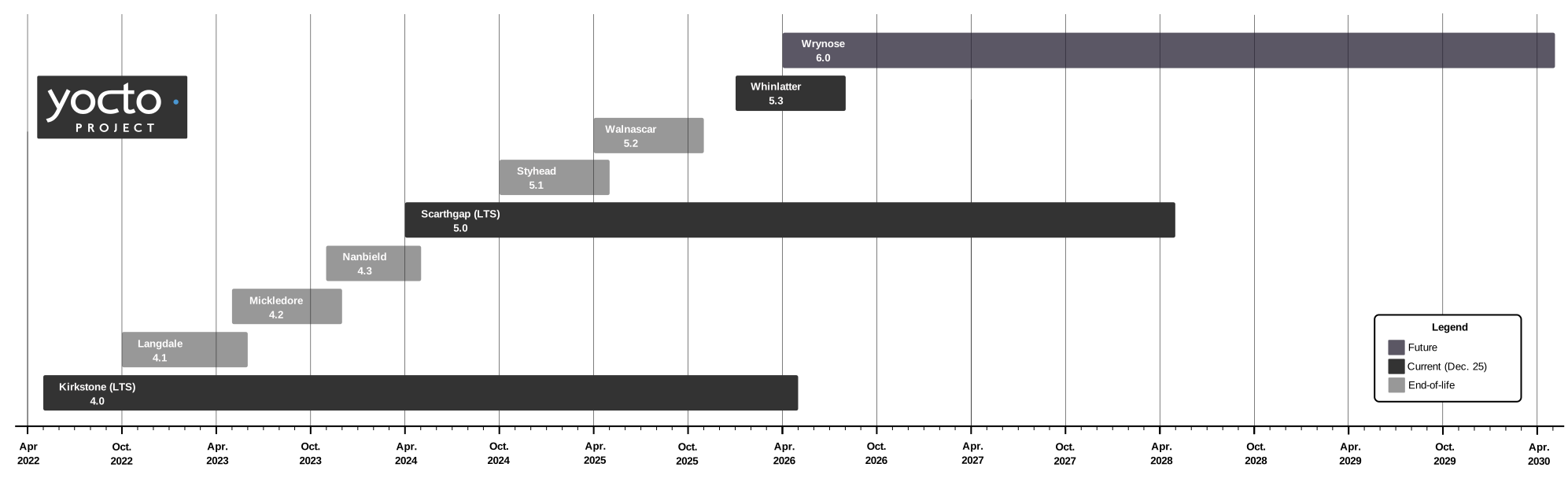
While stable releases are supported for a duration of seven months, some specific ones are now supported for a longer period by the Yocto Project, and are called Long Term Support (LTS) releases.
When significant issues are found, LTS releases allow to publish fixes not only for the current stable release, but also to the LTS releases that are still supported. Older stable releases which have reached their End of Life (EOL) won’t receive such updates.
This started with version 3.1 (“Dunfell”), released in April 2020, which the project initially committed to supporting for two years, but this duration was later extended to four years.
A new LTS release is made every two years and is supported for four years. This offers more stability to project users and leaves more time to upgrade to the following LTS release.
The currently supported LTS releases are:
Version 6.0 (“Wrynose”), released in May 2026 and supported until April 2030.
Version 5.0 (“Scarthgap”), released in April 2024 and supported until April 2028.
See https://wiki.yoctoproject.org/wiki/Stable_Release_and_LTS for details about the management of stable and LTS releases.
This documentation was built for the Blacksail release.
Note
In some circumstances, a layer can be created by the community in order to add a specific feature or support a new version of some package for an LTS release. This is called a Mixin layer. These are thin and specific purpose layers which can be stacked with an LTS release to “mix” a specific feature into that build. These are created on an as-needed basis and maintained by the people who need them.
Policies on testing these layers depend on how widespread their usage is and determined on a case-by-case basis. You can find some Mixin layers in the meta-lts-mixins repository. While the Yocto Project provides hosting for those repositories, it does not provide testing on them. Other Mixin layers may be released elsewhere by the wider community.
4.8 Testing and Quality Assurance
Part of the Yocto Project development and release process is quality assurance through the execution of test strategies. Test strategies provide the Yocto Project team a way to ensure a release is validated. Additionally, because the test strategies are visible to you as a developer, you can validate your projects. This section overviews the available test infrastructure used in the Yocto Project. For information on how to run available tests on your projects, see the “Performing Automated Runtime Testing” section in the Yocto Project Test Environment Manual.
The QA/testing infrastructure is woven into the project to the point where core developers take some of it for granted. The infrastructure consists of the following pieces:
bitbake-selftest: A standalone command that runs unit tests on key pieces of BitBake and its fetchers.sanity: This automatically included class checks the build environment for missing tools (e.g.
gcc) or common misconfigurations such as MACHINE set incorrectly.insane: This class checks the generated output from builds for sanity. For example, if building for an ARM target, did the build produce ARM binaries. If, for example, the build produced PPC binaries then there is a problem.
testimage: This class performs runtime testing of images after they are built. The tests are usually used with QEMU to boot the images and check the combined runtime result boot operation and functions. However, the test can also use the IP address of a machine to test.
ptest: Runs tests against packages produced during the build for a given piece of software. The test allows the packages to be run within a target image.
oe-selftest: Tests combinations of BitBake invocations. These tests operate outside the OpenEmbedded build system itself. Theoe-selftestcan run all tests by default or can run selected tests or test suites.
Originally, much of this testing was done manually. However, significant effort has been made to automate the tests so that more people can use them and the Yocto Project development team can run them faster and more efficiently.
The Yocto Project’s main Autobuilder publicly tests each Yocto Project release’s code in the openembedded-core, meta-yocto and bitbake repositories. The testing occurs for both the current state of the “master” branch and also for submitted patches. Testing for submitted patches usually occurs in the “master-next” branch in the openembedded-core, meta-yocto and bitbake repository.
Note
You can find all these branches in the Yocto Project Source Repositories.
Testing within these public branches ensures in a publicly visible way that all of the main supposed architectures and recipes in OE-Core successfully build and behave properly.
Various features such as multilib, sub architectures (e.g. x32,
poky-tiny, musl, no-x11 and so forth),
bitbake-selftest, and oe-selftest are tested as part of the QA
process of a release. Complete testing and validation for a release
takes the Autobuilder workers several hours.
Note
The Autobuilder workers are non-homogeneous, which means regular testing across a variety of Linux distributions occurs. The Autobuilder is limited to only testing QEMU-based setups and not real hardware.
Finally, in addition to the Autobuilder’s tests, the Yocto Project QA team also performs testing on a variety of platforms, which includes actual hardware, to ensure expected results.